

Key Highlights
-
Top-heavy index: 10 stocks now drive ~40% of the S&P 500.
-
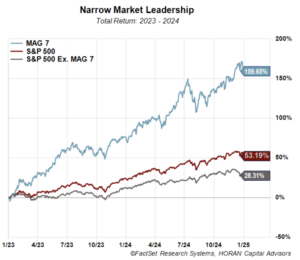
Big tech dominates: “Magnificent 7” surged ~160% vs ~28% for the rest.
-
Concentration risk: Your “diversified” fund may not be diversified.
-
Solution: Diversify beyond the index.
-
SFR benefits: Uncorrelated returns, inflation-resistant, stable cash flow.
-
REITs vs direct: REITs give exposure, but direct SFR can capture higher value.
Introduction
These days the vaunted S&P 500 looks less like a broad market and more like the S&P 50. A handful of mega-cap tech names now dominate the index. In fact, today only about 50 or so stocks drive the S&P 500’s performance (advisors.voya.com), meaning the rest of the 500 companies have far less impact. By one count the ten largest companies already make up ≈35–40% of the index’s total weight (clearbridge.com) (horanwealth.com). Imagine an “everyone’s invited” party where ten people do all the talking, that’s our index now. And it’s a sharp change: a recent Voya analysis notes this is the highest concentration since the 1960s, effectively turning your “diversified” index fund into an active bet on a very small roster (advisors.voya.com).
The Gulf Between The S&P 500’S Superstars And Everyone Else.
The chart below (from Horan Wealth) illustrates the gulf between the S&P 500’s superstars and everyone else. The blue line is the combined return of the “Magnificent 7” tech giants (Apple, Microsoft, Nvidia, etc.), which soared ~160% over 2023–24. The grey line shows the other 493 S&P companies, they only gained ~28% in the same span (horanwealth.com). In other words, just a few stocks turbocharged the index, while the rest mostly treaded water. This kind of top-heavy performance has few historical precedents, and it means riding an S&P 500 fund today is almost like betting everything on the tech sector.
Investors should be aware. When so much of the market’s eggs are in one basket, it raises the risk of unintended consequences. Historically, heavily concentrated markets make it very hard for active managers to outperform broad indices. Indeed, data show that only about 8% of large-cap funds beat the passive S&P 500 over the last decade (reuters.com), a reflection of how dominant those big names have been. (Put simply, if Microsoft and Nvidia soar, even a classic stock-picking fund struggles to keep up.) On the flip side, some market watchers worry this concentration is a bubble waiting to pop (reuters.com). If the biggest tech companies hit a stumbling block, the whole “diversified” index could tumble. As Reuters columnist Jamie McGeever puts it: “It’s ultimately a classic risk-reward dilemma. If you want a more balanced portfolio, diversify more because a sharp reversal in tech could trigger an outsized downturn” (reuters.com).
Why Broadening Out Makes Sense
So what can investors do? The cure for concentration risk is simply diversification, and not just by grabbing another S&P fund. As Morgan Stanley’s 2025 outlook advises, with stocks and bonds strangely marching in step, now is the time to “seek maximum portfolio diversification” (morganstanley.com).
Adding an Alternative Edge: Single Family Rentals
This brings us to a compelling strategy: housing as diversification, specifically single-family rental (SFR) homes. Consider the benefits. Rental housing performance tends to be uncorrelated with the stock market. A detailed analysis by Man Group notes that SFR returns do not move in lockstep with stocks or even other real estate sectors (man.com). In fact, the lone-house market is unique because only ~2–5% is owned by big institutions, the rest are mom and pop landlords (man.com). This fragmentation can work in your favor: it means rental prices and home values aren’t blown around by the same herd mentality that can grip stocks.

Moreover, long-term housing trends have been tailwinds for SFR. Millennials and growing families have driven strong demand for suburban homes, while home supply remains limited. Over the past 30 years, U.S. single family home prices and rents have grown faster than inflation (man.com), giving SFR a natural hedge in inflationary times. (Think of it as a “roof over your portfolio”, an asset whose value and income rise with living costs.) Institutional investors have noticed: though the SFR sector is still young, interest is growing. Research notes that institutional capital in SFR is currently in its infancy but poised to expand (armadaetfs.com). In mid 2025, big players made headlines by sinking multi billion dollar stakes into rental home funds. Even if you can’t buy houses yourself, you can access this theme via specialized REITs or funds, though their returns are typically lower and more volatile than direct ownership because you’re buying market-priced exposure, not underlying asset value.
By adding an SFR allocation, an investor puts some capital into an entirely different basket, a basket of houses rather than high tech gadgets. This can smooth out portfolio swings. As one expert summarized: “A compelling reason to add SFR to a portfolio is the diversification benefits it provides” (man.com). It’s like planting sturdy oak trees in your otherwise purely digital orchard, they grow on fundamentals (population and rents) that aren’t tied to the latest chip or software craze.
Of course, no strategy is magic. Housing still has risks (illiquidity, management hassle, regional downturns, etc.). But for many investors facing an ultra concentrated stock market, allocating even a small slice to single family rental real estate can lower overall risk and capture an inflation resistant income stream (man.com).
The Bottom Line
Today’s S&P 500 feels less like a broad market barometer and more like a handful of tech titans carrying the rest on their backs. That’s fine until it’s not. A prudent investor can treat this moment as a wake-up call: don’t lean solely on the familiar index. Consider boosting diversification by mixing in smaller companies, foreign stocks, bonds, or even alternative assets. In particular, think about single-family rentals as a counterweight. By spreading your capital across diverse asset types, including real estate, you build a portfolio with multiple strong legs to stand on, rather than one central pillar that could wobble.
In other words, don’t let your portfolio become another tech-exclusive remix of the S&P 500. Broaden the tune. The data and experts are clear: with the index so top-heavy, the safe play is to diversify right now (reuters.com). Treat the S&P 500 as just one ingredient, not the whole recipe, and you’ll be better prepared no matter which way the market winds blow.